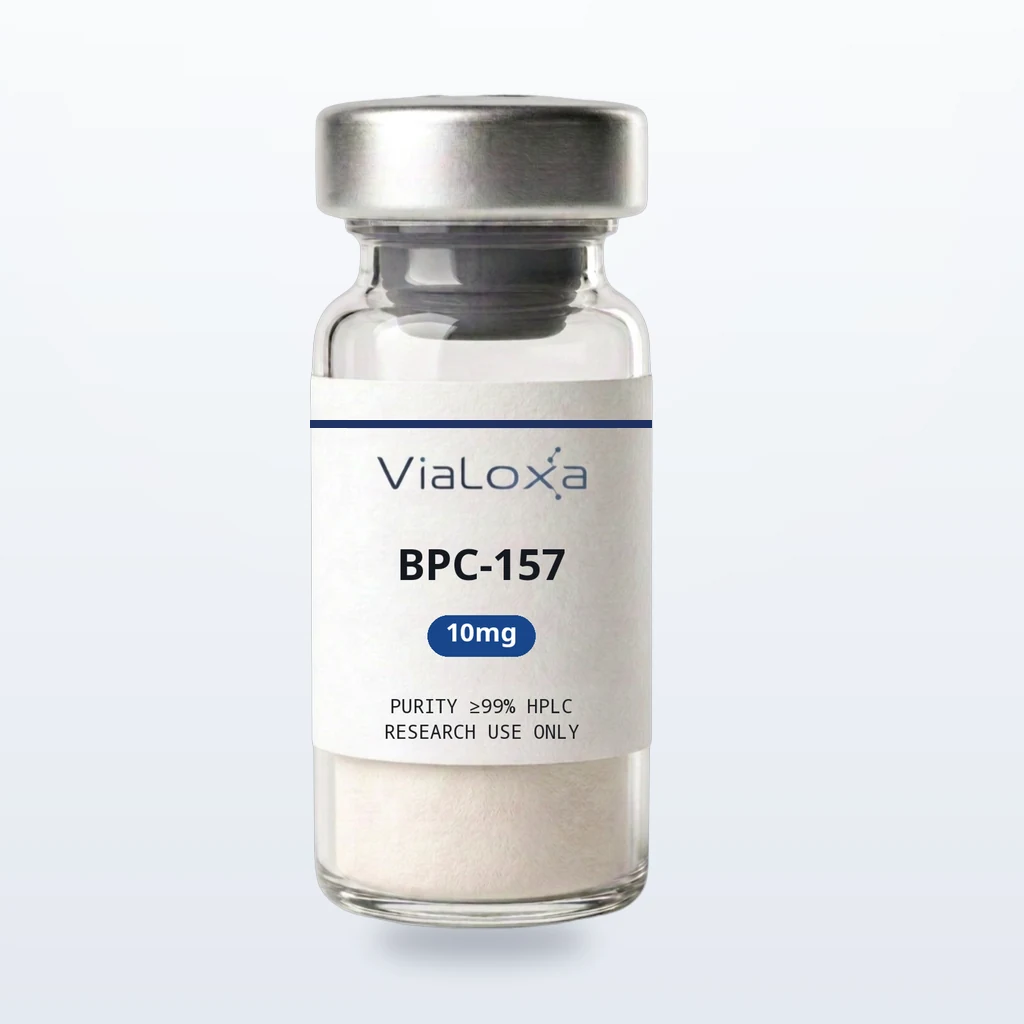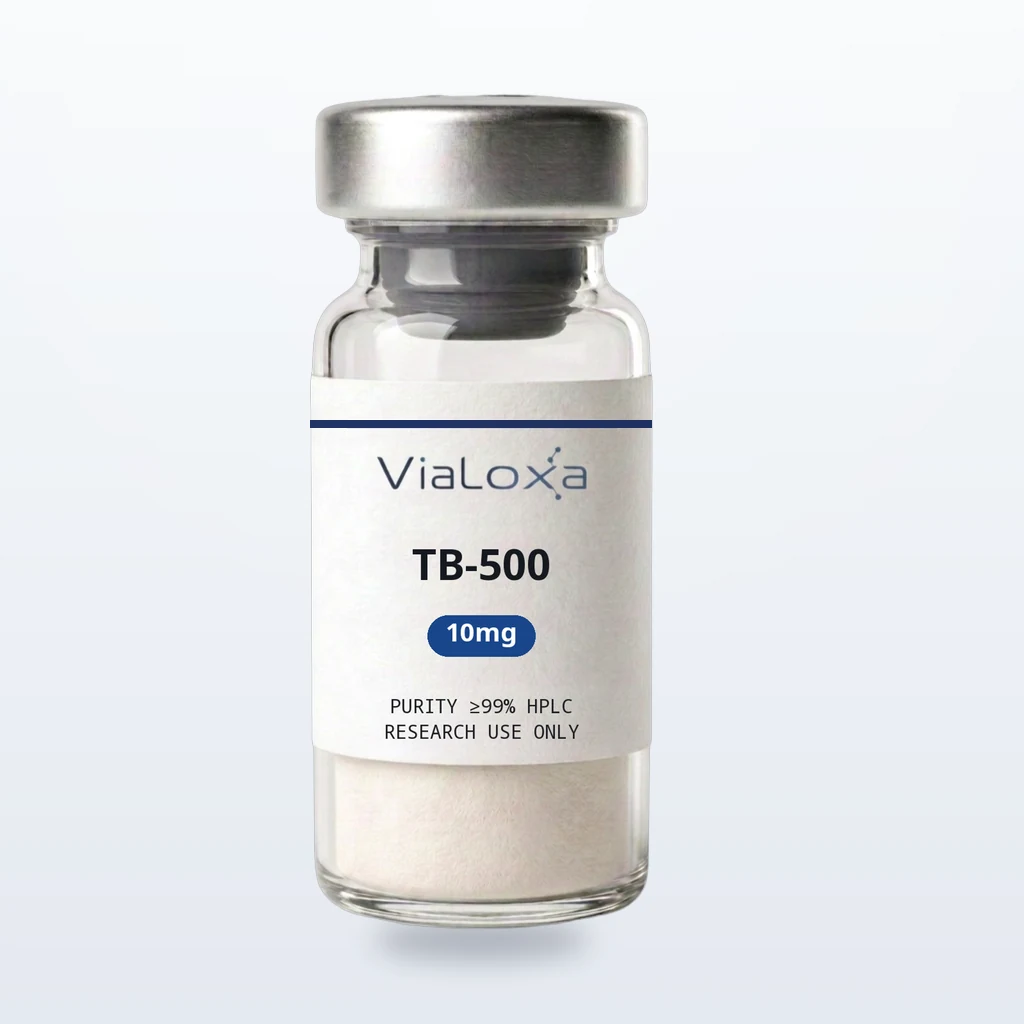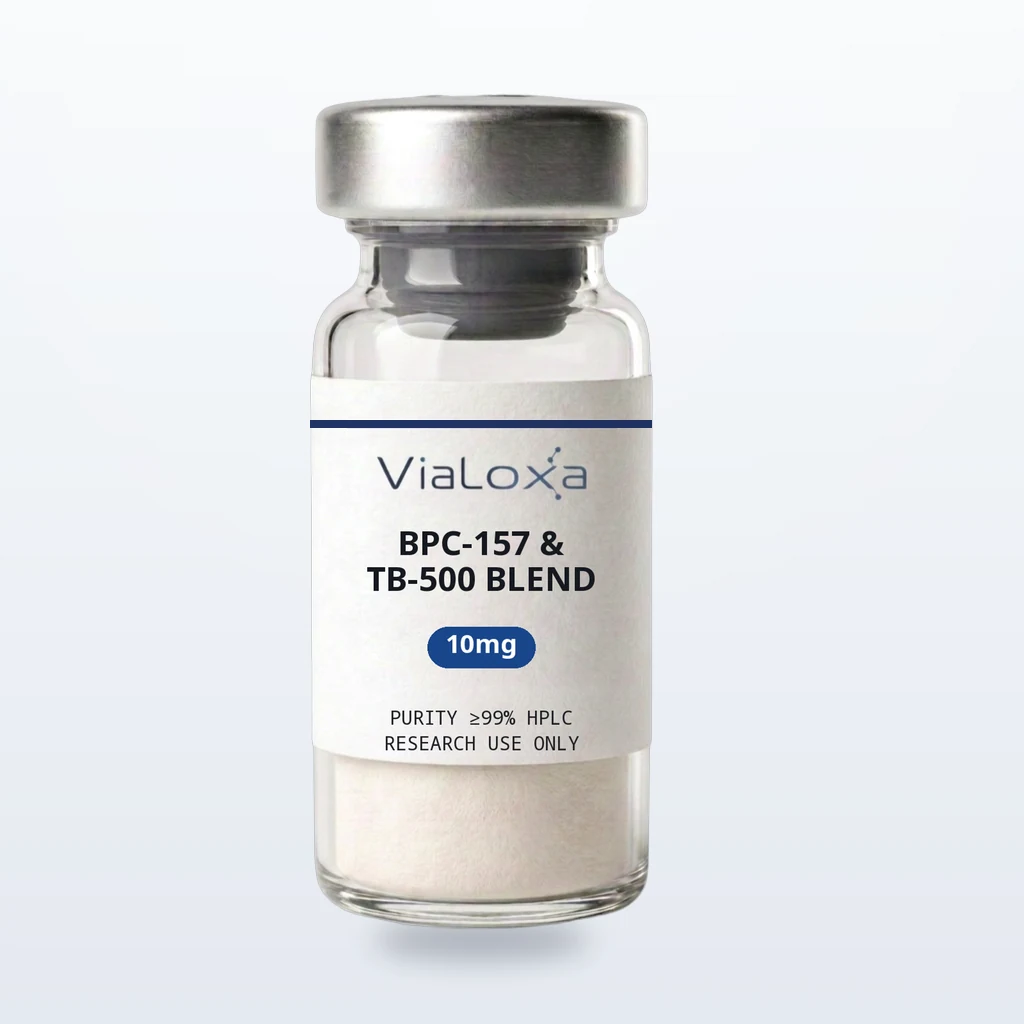

BPC-157 and TB-500 turn up together in so much tissue-repair literature that they are often treated as a single item. They are not - they come from different parent molecules, they are studied for different mechanisms, and they behave differently as reference standards.
This guide sets out what each one is, where the sequences come from, and why laboratories working in angiogenesis and tissue-repair models tend to hold both individually as well as in blended form. Both are unlicensed reference standards for in-vitro research only.
BPC-157: a synthetic gastric-juice fragment
BPC-157 is a synthetic pentadecapeptide - fifteen residues - whose sequence derives from a region of body protection compound, a protein identified in gastric juice. It does not occur in nature in this isolated form; it is a stable partial sequence constructed for research use.
Research interest centres on angiogenic signalling and on interaction with nitric oxide pathways in tissue-repair models. Its short length makes it a straightforward reference standard: it dissolves readily in water, gives clean chromatography and is comparatively forgiving in storage.
TB-500: the active region of thymosin beta-4
TB-500 is the synthetic actin-binding region of thymosin beta-4, a naturally occurring protein of 43 residues. Rather than reproducing the whole protein, TB-500 reproduces the fragment carrying the actin-binding motif, which is the part most work is interested in.
That actin-binding activity is the mechanistic hook: it places TB-500 in cell-migration and cytoskeletal-remodelling models, a different line of enquiry from the angiogenic signalling that dominates the BPC-157 literature.
Why protocols run them together
The two are studied for complementary rather than overlapping mechanisms, which is exactly why repair-model protocols so often include both. Running them together lets an experiment probe the angiogenic and the cytoskeletal contributions in the same model system.
Because that pairing is so common, we supply pre-blended references as well as individual vials. A blend is weighed and assayed as supplied, which removes a weighing step and the variability it introduces - useful when the ratio is fixed by protocol. Individual vials remain the right choice when you need to vary the ratio or run either peptide alone as a control.
- Individual vials - full ratio control, single-peptide controls possible
- Blended vial - one weighing step, certified as the combined material
Handling notes
Both reconstitute cleanly in bacteriostatic water and neither normally needs an acidic diluent. Add solvent down the vial wall and swirl; both are short enough that dissolution is quick, and neither benefits from agitation.
In solution, refrigerate and work within weeks. Where a standard has to stay quantitative for longer, aliquot into single-use volumes and freeze rather than cycling one vial repeatedly.
Sequence origin and what each fragment represents
Both compounds are fragments rather than full native proteins, and understanding what they are derived from explains why the literature treats them differently. BPC-157 is a fifteen amino acid sequence derived from a protein found in gastric juice, studied predominantly in gastrointestinal and soft-tissue repair models. TB-500 corresponds to an actin-binding region of thymosin beta-4, a protein involved in cytoskeletal dynamics and cell migration.
That difference in origin maps onto different mechanistic hypotheses. Work on the first has focused on angiogenic and growth-factor pathway effects in tissue models; work on the second has focused on actin sequestration, cell migration and epithelial coverage. Studies that treat them as interchangeable tend to produce results that are difficult to interpret in either framework.
Why they are frequently studied together
The two are often paired in tissue-repair research because their proposed mechanisms are complementary rather than overlapping: one line of investigation concerns vascular supply and signalling, the other concerns cell motility and structural reorganisation. Pre-blended references exist for exactly this reason, and they remove one source of preparation variance from a paired design.
A blend is only appropriate where the study question concerns the combination. Where the question is about attribution, separate vials and separate arms are the only design that can answer it, because a blend cannot be decomposed after the fact.
- Blend: the combination itself is the object of study
- Separate vials: attribution between the two is the question
- Either way, record the ratio and lot numbers used
Purity considerations specific to these sequences
Both sequences are short enough to synthesise cleanly, which means high purity figures are the expectation rather than a distinction. The impurities worth attention are deletion sequences differing by a single residue, which co-elute closely with the target and are visible only in the shape of the main peak rather than as separate peaks.
Read the certificate of analysis with the detection wavelength and gradient in view. A high purity figure produced by a short gradient at an unhelpful wavelength conveys less information than a slightly lower figure from a longer, better-resolved run.
Practical preparation notes
Neither sequence is troublesome to prepare. Both dissolve in bacteriostatic water within a minute of gentle swirling, and neither normally needs an acidic diluent. Both are stable as lyophilised powder for the usual long periods and both follow the standard weeks-not-months rule once in solution.
The most common preparation error with these two is not chemical but clerical: mixing up which vial is which when both are in front of you at the same concentration. Label at the point of reconstitution, before the second vial is opened.
- Bacteriostatic water for multi-use vials
- Swirl, never vortex or shake
- Label both vials before opening the second
- Refrigerate immediately and record the reconstitution date
Everything described here relates to unlicensed reference standards supplied for in-vitro laboratory research by qualified professionals. Nothing we sell is a medicine, and nothing on this page is medical guidance. See our research use disclaimer.
Frequently asked
- Are BPC-157 and TB-500 the same class of compound?
- No. BPC-157 is a synthetic fifteen-residue fragment derived from a gastric protein sequence; TB-500 is the synthetic actin-binding region of thymosin beta-4. They share a research field, not an origin or a mechanism.
- Should I buy the blend or the individual vials?
- Buy individual vials if you need to vary the ratio or run either peptide alone as a control. Buy the blend if your protocol always uses both at a fixed ratio and you want one certified weighing rather than two.
- Do either of them need special reconstitution?
- No - both dissolve readily in bacteriostatic water. Follow the usual practice of adding diluent down the vial wall and swirling rather than shaking, then refrigerate and record the reconstitution date.
- Is a blend or two separate vials better for research?
- It depends entirely on the question. A blend is appropriate where the combination itself is under study and removes preparation variance between arms. Separate vials are the only option where the study needs to attribute an effect to one compound rather than the other.
- Do the two need different diluents?
- No. Both dissolve readily in bacteriostatic water with gentle swirling and neither ordinarily needs an acidic diluent. Follow the same practice for both: diluent down the wall, no shaking, refrigerate promptly and record the date.
- What impurities should I look for on their certificates?
- Single-residue deletion sequences, which co-elute close to the main peak and show up as asymmetry rather than as a separate peak. Read the purity figure alongside the gradient length and detection wavelength, because a short run can conceal exactly this class of impurity.